
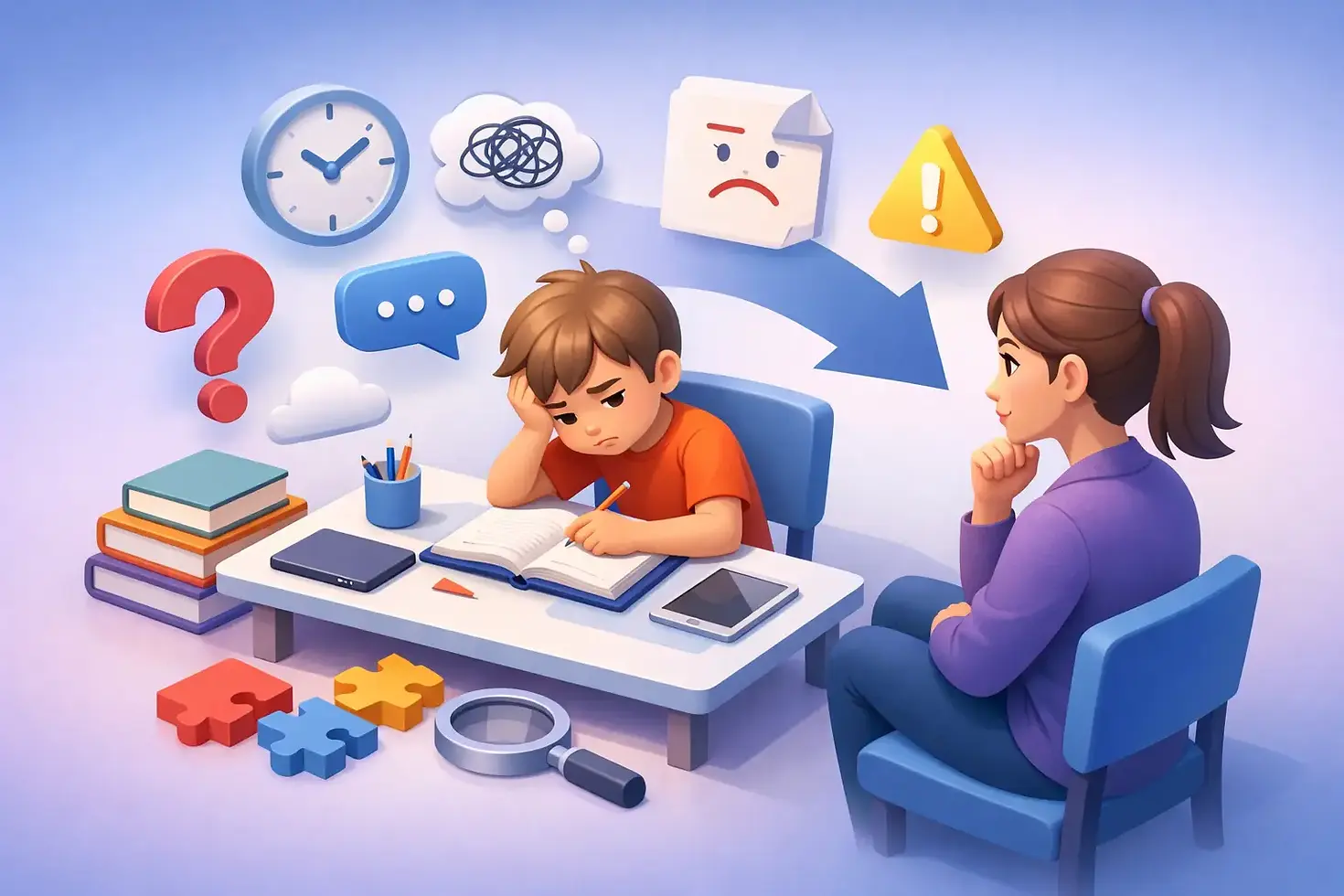
Top Signs Tutoring Is Needed for Your Child
- Julian Lewis
- Apr 22
- 6 min read

A student does not usually say, "I need a tutor" right when support becomes necessary. More often, the top signs tutoring is needed show up slowly - a homework battle that keeps getting longer, a test grade that drops without warning, or a child who used to participate but now stays quiet. For families, the challenge is knowing the difference between a temporary rough patch and a pattern that needs action.
The good news is that early support can change the direction of a school year. Tutoring is not only for students who are failing. It can also help students who are frustrated, inconsistent, underconfident, or simply not getting what they need from the pace of the classroom. When families respond early, students often regain clarity, improve performance, and feel more capable again.
Top signs tutoring is needed at home and at school
One of the clearest signs is a steady drop in grades. A single low quiz score is not always a reason to worry. Students have off days, difficult units, and adjustment periods. But when classwork, homework, quizzes, and tests all start trending downward, that usually points to a deeper issue with understanding, study habits, or retention.
Another sign is when homework becomes unusually stressful. If a child regularly spends far too long on assignments, needs constant parent help, or ends each evening upset and exhausted, the problem may not be effort. It may be that the material is no longer clicking. Parents often assume more time should solve the issue, but more time without the right support can lead to more frustration instead of progress.
Teachers also provide useful signals. If you hear that your child is missing key concepts, rushing through work, struggling to stay organized, or not participating in class, those comments should be taken seriously. Academic struggles do not always show up as failing grades right away. Sometimes a student is doing just enough to get by while understanding less than it appears.
A sudden loss of confidence matters too. When students start saying things like "I'm just bad at math" or "I can't read like the other kids," they are often describing a pattern of repeated difficulty. Confidence affects performance. A student who expects failure may avoid trying, stop asking questions, or freeze during tests even when they know more than they think.
When academic struggles are more than a temporary dip
Every student has difficult moments. A hard teacher, a new school year, or one challenging unit can temporarily shake performance. The question is whether the struggle passes with normal classroom support or keeps returning.
If your child studies but still cannot explain what they learned, tutoring may help. Memorizing enough to survive a quiz is not the same as building real understanding. This is especially common in math, reading comprehension, science, and writing, where each new skill often depends on a stronger earlier skill.
You may also notice inconsistency. Some students earn an A one week and a D the next, not because they lack ability, but because their foundation is uneven. They understand certain topics and completely miss others. That kind of uneven performance is easy to overlook, yet it often becomes a bigger problem as coursework gets more advanced.
Test anxiety can be another clue. If a child seems to know the material at home but performs poorly on assessments, the issue may include confidence, pacing, or weak academic routines. Tutoring can address content gaps, but it can also help students learn how to prepare, practice, and approach schoolwork with more control.
Top signs tutoring is needed by grade level
In elementary school, the biggest warning signs often involve reading, basic math, and attention to directions. A student who struggles to sound out words, read fluently, understand what they read, or recall math facts may need more targeted instruction than a busy classroom can provide. At this stage, early intervention matters because foundational gaps tend to follow students forward.
In middle school, organization becomes a major issue. Students are managing multiple teachers, larger assignments, and greater independence. A child who loses work, forgets deadlines, or seems overwhelmed by routine expectations may not be lazy. They may need structured academic support to build systems and keep pace.
In high school, tutoring is often needed when content becomes more specialized and fast-moving. Algebra, geometry, biology, chemistry, and essay writing can expose weak foundations quickly. Older students may also hide their struggle longer because they feel embarrassed or want more independence. By the time parents notice, the student may already be behind in several areas.
Emotional and behavioral signs parents should not ignore
Academic struggle does not stay neatly inside a report card. It often shows up in mood, behavior, and motivation. A student who avoids homework, complains of headaches before school, or becomes irritable every evening may be responding to academic stress.
Avoidance is a common sign. Some students procrastinate, ask to skip school, or suddenly become distracted whenever certain subjects come up. Others shut down completely. They stare at the page, give one-word answers, or insist they "don't care." In many cases, they do care - they just do not want to keep feeling unsuccessful.
Perfectionism can also signal a need for support. Not every struggling student looks disengaged. Some become intensely anxious about getting everything right because they are working hard to cover uncertainty. They may cry over small mistakes, redo assignments repeatedly, or panic before tests. That response deserves attention too.
Why waiting often makes the problem bigger
Families sometimes hold off on tutoring because they want to see whether things improve on their own. That can make sense for a brief period, especially after a transition or schedule change. But if the same concerns continue for weeks, waiting usually allows confusion to build.
Most subjects are cumulative. A student who misses a reading skill in third grade, a fraction concept in fifth grade, or an algebra foundation in eighth grade may keep moving forward without fully catching up. Eventually the workload becomes heavier, the confidence drops, and recovery takes more time than it would have earlier.
There is also a practical side. When students feel behind for too long, they often need support in both content and mindset. Starting earlier can prevent that cycle. It is easier to build momentum when a student still believes improvement is possible.
What good tutoring support should actually do
Tutoring should do more than help a student finish tonight's homework. Effective support identifies where the breakdown is happening and gives the student a clear path forward. Sometimes the issue is missing foundational skills. Sometimes it is pacing, attention, organization, or study habits. A quality tutoring approach responds to the actual need rather than applying the same solution to every student.
Families should also expect tutoring to build confidence alongside performance. When instruction is clear and targeted, students usually begin participating more, working more independently, and feeling less intimidated by school tasks. Progress may start with grades, but the bigger win is when confusion begins to lift.
That is why flexibility matters. Some students do best with in-person support. Others need online sessions that fit a busy family schedule. In many cases, a hybrid option makes ongoing help more realistic. What matters most is consistency and instruction that meets the student where they are.
For schools and districts, the same principle applies at a larger scale. Students benefit most when academic support is structured, dependable, and led by qualified educators who understand how to close learning gaps without adding confusion.
Knowing when to take the next step
If you have noticed one sign, monitor it closely. If you have noticed several - falling grades, homework stress, teacher concerns, low confidence, avoidance, or uneven performance - it is time to act. You do not need to wait for failure before getting help.
Support works best when it is proactive, not last-minute. A student who receives help early has a better chance of rebuilding skills, restoring confidence, and approaching school with less stress. At UPLIFT Educational Solutions, that belief is simple: where confusion ends and confidence begins, real progress can take hold.
If your child is showing the top signs tutoring is needed, trust what you are seeing. Timely support can turn frustration into growth, and one strong step now can make the rest of the school year feel a lot more manageable.



Comments